Showing posts with label COVID. Show all posts

Wednesday, May 25, 2022

Jan to March 2022

 As the COVID epidemic waned, public services resumed. Most importantly the APSRTC bus service to villages restarted. This helped patients easily access the RHC. The curbs on gatherings were also removed, schools restarted and all this meant we saw an uptick in the number of patients accessing the RHC.

TOTAL: 3949 - slowly approaching the monthly pre COVID Figures of 1500 per month
Children: 105 (52 M : 53 F), Elders: 692 (407 M: 285 F)
Adults: 3152 (1452 M : 1700 F)

The COVID pandemic has had an impact on mental health too. A number of students had trouble readjusting to school / college after the long lay off. Difficulties in concentration, restlessness, somatization were all common symptoms. Counselling helped a great deal. A few of the students needs short courses of Anti Depressants.
Adults were similarly affected. Loss of income, loss of crops, working children being laid off all played a part. For many of them, they had exhausted all their coping strength over the years. Faces wore a sense of hopelessness. Many of them needed Anti Depressants and a lot of encouragement. The hope came back as the restrictions were removed, providing much needed income to the families.
Lets hope that the COVID pandemic peters out and is limited to small outbreaks only

Wednesday, November 03, 2021

Learnings from an Epidemic: Looking back and "Forward"

      This post is a collection of my personal thoughts on the COVID pandemic as it unfolded. In previous posts I have written about the impact on the people in our neighbourhood. 
    I am certain that much of what I have written below has been articulated at some time or the other by others. 

PANDEMICS

     The world had forgotten what Pandemics are and the havoc they cause. The 1918 flu pandemic has been largely forgotten, maybe a distant  memory in some. The Asian flu pandemics of the late 50s and 60s, lasted about a year causing between 1 - 4 million deaths worldwide. The lessons from these were consigned to dusty pages of Textbooks on Community Medicine. Most of us doctors, just read these answered questions in an exam and promptly forgot about it!

    Ebola, SARS, Swine Flu all reared their heads but did not sweep the world. Advances in medicine, hygiene, vaccination etc. all probably ensured that these epidemics were controlled. There were possible Virologic factors too which limited the spread of the disease.

    In Dec 2019, the first reports surfaced of a new Virus with high morbidity and mortality emerged from Wuhan in China. Just as the rising sun seeks out and illuminates all in its path,  the CORONA Virus spread through the world seeking out every nook and corner, affecting every part of the world. None were spared the Viruses reach, cutting through swathes of humanity. Panic and mayhem followed in its wake.

    The medical community was scrambling to find answers being demanded by the administrators and people. In a sense, advances in hygiene, medicine, investigations, drugs and technology had kept COMMUNICABLE/INFECTIOUS DISEASE EPIDEMICS at bay. The epidemics of old were consigned to history and possibly only distilled lessons from these epidemics remained in text books. 

    The silent epidemic of NON COMMUNICABLE diseases was the talking point everywhere. Minor outbreaks  of Ebola, H1N1 etc. were quickly contained. Ebola with its high mortality, is scary but it never spread, though the threat of that remains.

    CORONAVIRUS changed all that. The virus spread rapidly throughout the world. The virus did not conform to patterns of behaviour of other Influenza viruses. Winter, Summer, Rain were all the same for the Virus. While in China, Europe and USA the virus ravaged the populace in Winter, In India and Asia it was in Summer. Geographically, every country in the world North South East or West has been affected.  In the midst of all this chaos a pattern emerged:

    Crowded, ill ventilated places seemed to have a higher incidence of Viral infections and associated morbidity and mortality. As such, In India at least, Rural India was less affected than Urban India. Urban includes small towns (so called Tier III towns too).

    So fresh air and ventilation seemed to halt the spread of the Virus. In our rural hinterland almost all the cases were imported, with people coming back from the cities with the infection.

SEARCHING:
    There was a mad rush to find the pathophysiology of the disease. What were the factors that caused the virus to spread so rapidly, why was it causing so many deaths, what could be done to prevent deaths, how to prevent spread and mortality etc.?
    Stories and pictures of hospital wards overflowing, patient lining up for admission, fighting for Oxygen became common place.
    Medical Teams were treating only those who had a chance of survival. Many were given, palliative treatment, the best that could be offered. That brings me to the concept of Triage. Not many medical personnel are familiar with this concept. Primarily used by the Armed Forces and Emergence Medical Services - specialists in Hospitals have really no idea of this concept.

TRIAGE
    In the Armed Forces, during War, where mass casualties are expected - we were trained to spread to our resources to benefit the maximum. Use the resources to Save as Many as possible. Quickly dispose of those less serious so that the load comes down. Axiomatically that meant that some of the seriously injured were stabilised and treated only when possible. 
A more detailed reading: https://en.wikipedia.org/wiki/Triage


COVID PEAKS 
    A similar situation unfolded with the COVID outbreaks too. Hospitals in India and across the world were overwhelmed by the sheer number of sick people that reached them. There was a shortage of everything - Personnel, Beds, Oxygen, Fluids, ambulances - name it and it was short. Medical personnel worked continuously through the months of the epidemic peak. Even in war, one does not see so many casualties all coming in at the same time. All medical personnel, from the Doctors to the ward aids will have stories to tell and memories of harrowing work in the hospitals. It is not easy to deal with a deluge of deaths, patients seeking succor where none exist. 
    As an example: 
    WW II saw about 21 - 25 million military deaths (including 5 million in captivity) - for the period Sep 1939 to Aug 1945 (06 years)
    As of Nov 2021 - COVID 19: Death: 5.1 million from Jan 2020 to Nov 21.
    The number of deaths are comparable on an annual basis. However, do remember that during the war, there were many other factors like, lack of food, access to health services which were also impaired

    Civil society came to the forefront - lending a helping hand in whichever way possible. Stories abound of people opening their resources to those affected. So also for the Great Migration that took place in April May of 2020. I am sure that someone somewhere will chronicle these stories so that people do not forget.

CONFUSION and MISTEPS
    The search for a cure, stemmed from an initial rudimentary understanding of the Virus and the disease process. ACE receptors, Cytokine storm, Multi Inflammatory Syndrome, CORADS score all became household words!! 
    Ever so often there was an article touting this drug or that drug as a miracle - Hydroxychloroquine, Doxycycline, Ivermectin, Remdesivir etc. all were touted and none have lived up to their initial hype.

    There were so many "SCIENTIFIC ARTICLES" each claiming to know it all. For us doctors it became impossible to separate the chaff from the grain. None of us knew what works or what does not. 

Retraction Watchhttps://retractionwatch.com/retracted-coronavirus-covid-19-papers/
Retracted:                                                  149
Retracted due to Journal Error                      12
Retracted and Reinstated                             05
Expression of Concern                                  07

Similarly 06 Papers in high impact journals were retracted within 30 - 45 days of publication: https://pubmed.ncbi.nlm.nih.gov/33989091/

What of the World bodies; WHO, CDC, NHS, ICMR?

    As with the rest of medical community these organisations were also grappling with the unknown. From an initial response in which the Pandemic or rather the seriousness of the disease was played down to finally getting some sort of understanding of the transmission and disease process - the journey was arduous and filled with missteps.
    Advisories sent out, recommendations made and then modified/rescinded. Treatment protocols changed overnight. 
 
PREVENTION
    The recommendations on Masking, Distancing and Personal Hygiene formed the bedrock of prevention. These have been valid since time immemorial. To add to the above came the renewed emphasis on Ventilation.

    Recommendations on the use of PPEs changed over time as the medical community slowly understood Viral behaviour. While masking was mandatory, the space suits were consigned to the ICUs and places where Aerosols were generated. Then came the finding that the Virus was capable of Airborne transmission. So this led to the recommendation of Ventilation.

    At the Rural Health Centre - from April 20 - we shifted to outdoor clinics. We had the space to do so. Of course most patients were treated strictly NO TOUCH TECHNIQUE.  I remember as a student, passing snide comments on one of our Teachers, who never touched a patient. All of us thought very poorly of the professor. None of us knew that 40 years down the line we will be doing exactly the same thing.

GRAPPLING
    Physicians devised their own treatment protocols, most with some rationale behind their use. Most of us stuck to a sort of common sensical approach, approaching it like a Viral fever, but with much more care. Received wisdom (what is taught in medical school and thereafter) was of no use. So also Perceived Wisdom (based on scientific articles, observations, patterns of fever etc.) was also of no use. The virus changed its spots (genetic code) faster than any known virus. I think that the few things which sort of worked were Hydration, rest and fever mitigation. As a primary care physician, I have only a vague second hand understanding of how it was in Critical Care Units and dealing with patients with Hypoxemia.

COOPERATION & SPEED
    What has stayed with me has been the speed of the response and massive amount of material which was available as open source. Technology was leveraged in a way never before, setting a possible template of responses for future epidemics.
    Just look at the speed with which, Viral genetic sequencing was done and data shared world wide.

Global Initiative on Sharing Avian Influenza Data (GISAID): https://www.gisaid.org/

Reproduced below is a graph showing the extent of collaboration: https://www.nature.com/articles/d41586-021-01069-w


    In India the Department of Biotechnology established 
INSACOG (Indian SARS-CoV-2 Consortium on Genomics (https://dbtindia.gov.in/insacog) 
This consortium is able to quickly trace Mutations and helps track the disease spread.

VACCINES
    Thanks to gene sequencing, Vaccines were quickly produced and tested. 
    GAVI - the alliance for Vaccines and Immunisation is a fine example of this collaboration.   https://www.gavi.org/ 

(Gavi, officially Gavi, the Vaccine Alliance (previously the GAVI Alliance, and before that the Global Alliance for Vaccines and Immunization) is a public–private global health partnership with the goal of increasing access to immunization in poor countries. )

 If one looks at the speed with which the vaccines were developed, the chart below gives you an idea. In less than a year there were multiple vaccines available. 

https://ourworldindata.org/vaccination


Another excellent resource on vaccination is: https://www.historyofvaccines.org/

SUPPORT and SHARING

    I have always felt that "tech" has taken over our lives  - Ironically, as I write this on my laptop, the material is being saved in some cloud somewhere and people all over the world can access this piece.
    For all the deriding of the WhatsApp University - this platform became invaluable during the pandemic. Widely used to mobilise support, exchange information on hospital beds, oxygen status etc. it proved invaluable in providing peer support to families struggling with COVID. 
    For doctors it was a platform where information and constantly evolving best practices were shared. This exchange of ideas and thoughts from all corners of the world was and continues to be invaluable.
    Of course one had to be careful and separate the ludicrous from the ridiculous. Nuggets of great importance had to be searched for!

  Anecdote:  I was approached for help in Delhi for a Rishi Valley Alumni. The doctor treating him was an AFMCite, a couple of years my senior. Through the AFMC network was able to trace him and speak to him. The patient pulled through, giving all some very anxious moments in between. 

OPEN SOURCE DATA

    Volunteer driven, crowd sourced effort to track the COVID outbreak in India - https://www.covid19india.org/
This website was a lifeline for us, working in the field. Up to date and informative, this became one of the most trusted data sources for us. Unfortunately the website shutdown on 31 Oct.
The other website https://www.worldometers.info/coronavirus/ 
Patterns and progressions of disease in every country in the world was mapped. 
It was terrible seeing the number of people affected world wide. One could also the numbers exploding as the pandemic reached its peak in the affected parts of the world. 

ARTICLES:

Dr MS Seshadri and Dr T Jacob John have been regularly publishing articles in the print media. For those interested all these are available online.
Dr Shankar Subramaniam from the Armed Forces has a number of very interesting publications, including one on Mathematical Modelling and another the largest study on Vaccine efficacy. All available online

THE FUTURE: 
    It is impossible to foresee the shape of the COVID 19 pandemic. Foresight is 6/60 and hindsight is 6/6 vision!!
However - I am giving it a shot
1. This pandemic will slowly move towards endemicity - with few local outbreaks
2. There will be other Viral pandemics in the years to come. 
3. Human beings will necessarily have to change the way we live - in what way I do not know, but the lockdowns have given us an inkling of shape of life to come. 
4. We will all need to care for the environment in a much more holistic way. At present humanity is at odds with itself and with the environment.
4. However, human ingenuity will continue to seek answers and am sure that humanity will find a way to live at peace with itself and the environment.

STAY SAFE AND HEALTHY
Kartik


Friday, July 03, 2020

Through the lockdown - April to June 2020

The experiences and learnings of the last three months need to be documented for successive generations of health care professionals.
COVID 19 has made us look anew at  disease epidemiology, progression, pathogenesis and management protocols. All of us, HCPs, have been involved in trying to understand, contain and control this pandemic. To a large extent we have been groping in the dark trying to understand this virus. Theories propounded only to be debunked in a few short weeks. 
To me it is reminiscent of the way humanity grappled with Cholera, Typhoid, Small Pox and Plague in the late 19th and early 20th century. It is only from the mid 1950s were we able to get a handle on infectious diseases. When I read accounts of past epidemics, I sometimes wonder how people could have been so stupid and not followed what we, today consider as basic tenets of hygiene, wound care etc!
I am sure that 30/40/50 years down the line, Health Care Professionals will laugh at the way we handled the COVID pandemic and feel the same way.
What has definitely improved is possibly personal hygiene - washing hands, feet before entering home, not shaking hands, maintaining a distance etc. 
However as time goes on, there has been an acceptance that this disease is not going away in a hurry. We have to learn to live with this and protect ourselves to the extent possible.

Patients have been trickling in through the lockdown, finding someway of accessing the RHC. There is a sense of trust and faith in the RHC. Many youngsters just come to collect medications for their grandparents or elders in their village. A coming together of the community, helping each other; something which has not been prevalent last many years.

Total Patients: 1383 (Our normal monthly attendance is about 1500 patients)
The majority of them (1355 patients) earned less than 48000 pa.
Children accounted for 26 and elders 385.

SOME PHOTOGRAPHS

Patient Screening at RHC, the masked staff of the RHC

Getting Ready

Screening
Staff waiting for the patients


PATIENTS - Patience is the name of the Game


Orderly queues outside the RHC. Distancing maintained


Waiting for her turn

An elderly couple with their daughter in law
 

Relaxing on his tricycle!


A shoulder to lean on - much needed


Medicine distribution


Waiting for Medicines
 

Food for the Soul

 
The open air eatery run by this couple


A tree falls

An old Peepul tree more than 70 years old, died. Successive droughts had battered it and then possibly a fungal attack on its roots, withered the tree from inside. The tree had to be brought down before strong winds uprooted it.


Thats for Now Folks


Wednesday, April 29, 2020

A Rural Health Centre in the times of Covid - during lockdown

The Corona virus pandemic sweeping across the world had its fallout on the health centre also.
None of us were prepared or knew what to do, how to deal with patients, what was the infectivity, transmission etc.
There was also a lot of fear and false information generated amongst the public, largely due to a lot of misinformation and myths being propagated on social media.
On the 22nd of March a 01 day Janata curfew was imposed, to which people responded positively.
The Government then decided to impose a 21 day lockdown from the 24th of March till the 15th of April.
This threw us into a quandary. How to run the health centre in these times?
Some of the problems are given below
1. Staff could not come from Madanapalle, since there were no buses or public transport plying.
2. Patients could not access the health centre from their remote villages.
3. More than 90% of our patients are from Below Poverty Line Rural families, and are dependent on the RHC for their tests and medicines.
4. Should the RHC be kept open and in the process, expose ourselves and staff to possible danger?
5. There were some confusing messages from the IMA, AP Govt and Centre, initially, which then were clarified.

The lockdown was further extended to 03 May with  some restrictions being lifted from 20th April.

OUR RESPONSE 
1. Keeping RHC open
This was essential, in the spirit of humanism, compassion, caring etc etc, the RHC had to be kept open.
We worked with skeleton staff, multi tasking, reducing the tests, turn around time.
All the staff were given masks as well as gloves and continuously educated on personal hygiene.

2.  Patients attending the RHC
1. We set up a hand washing area with soap  and water. One of our staff ensured that the patients washed their hands before coming to the reception
2. Segregation of all those patients who had fever, cough or breathlessness.
These were examined by a specified doctor and nurse, with masks and gloves. Fortunately none of them had history of contact, travel etc. None of them also had symptoms of Severe Acute Respiratory Illness (SARI) or Influenza Like Illness (ILI)
3. Fast tracking of asymptomatic patients who reported either
a. A member of their household with respiratory illness.
b. Respiratory illness in the street/village.
4. Social Distancing was put in place at the outset itself
5. Since most of our patients have Non Communicable Diseases (Hypertension, Diabetes, Heart Disease) it was easier to sort out and quickly do their tests and send them back home.
6. For those patients whose phone numbers were available, we called them and asked them to continue medications from local medical stores or from Government hospital.

Teleconsult: 
We set up a 24 hour mobile number, answered by one of our staff to answer all queries.
Those needing consult with doctor were given a landline number to call between 0830 -1030 to speak with a Doctor (Dr Kartik).
A number of patients were treated this way. Some of them, however chose to come all the way to the RHC to see the doctor and collect medications. Faith I presume and also a morale booster in seeing a familiar presence in these uncertain times

Patient Attendance
Daily we are seeing about 30 - 40 patients, which is 1/3 of our normal load.
Patients are being constantly educated on safe practices during the ongoing lockdown. We are also reiterating the need to continue with these practices once the lockdown is lifted and "normalcy" is restored.

Sensitisation:
We talked to the workers, staff and workers of the Rural Education centre and other staff of Rishi Valley. We also addressed some village volunteers/ elders educating them on

The Corona virus: What is the it, why it is spreading, the disease it causes and that prevention is the key to keeping safe through the following:
a. Personal Hygiene
b. Social distancing
c. Use of masks

PHC: 
We also worked with the ANMs, ASHA workers and the PHC Kurbalakota doctor in charge. Doctor Sreenivas has done a real great job of monitoring and ensuring preventive measures.

PROBLEMS
1. Accessibility: Our patients mostly come from a radius of  30 km. They were not able to access the RHC since there was no public transport. However, in due course of time, some of them hitched rides on motorcycles or sent their hospital books to the RHC for refill of medication.
2. Medicine availability: By the 07th of April we had started running out of common user medicines like anti hypertensives, oral anti diabetics and Insulin.
Our response was to lower the dose, accepting higher sugars and blood pressure levels, fully knowing the risk such an approach posed. The rationale was that something is better than nothing and also ensuring that whatever is remaining is able to serve a larger population - the principle of Distributive justice.
3. Lack of PPE: We made do with using a combination of surgical mask and a cloth mask. Double layering. Getting an N95 mask was next to impossible. We were also reusing surgical masks after drying in shade.

Some Pictures from the RHC


Social Distancing in the Patient waiting area


Seat Markings
                          
                                        
Place Markings


Enjoying a meal after their sugar tests.
These 2 from the same village traveled 60 km one way to collect medicines


Bikes parked outside the RHC


Blood tests in the verandah of the RHC


19th April: Resuming supplies

Medicines:
Medicines reaching the RHC
A special goods train carrying medicines was scheduled from Vadodra to Bengaluru and Coimbatore. In that train 23 boxes for the RHC were loaded from LOCOST Vadodra. These boxes were unloaded at Dharmavaram junction, about 150 km to the north of us.
Am inter district permission to transport medicines was obtained by our pharmacist.
Unloading
An intrepid luggage auto driver, drove to Dharmavaram  and brought back the medicines for us.
Indian ingenuity and determination always works.
Boss Maal aa gaya


Medicines being dispensed - Kept in a stool and explained to patient

Patient Comfort - Tea made in a nearby village to be served to the patients coming to RHC


PPE: 
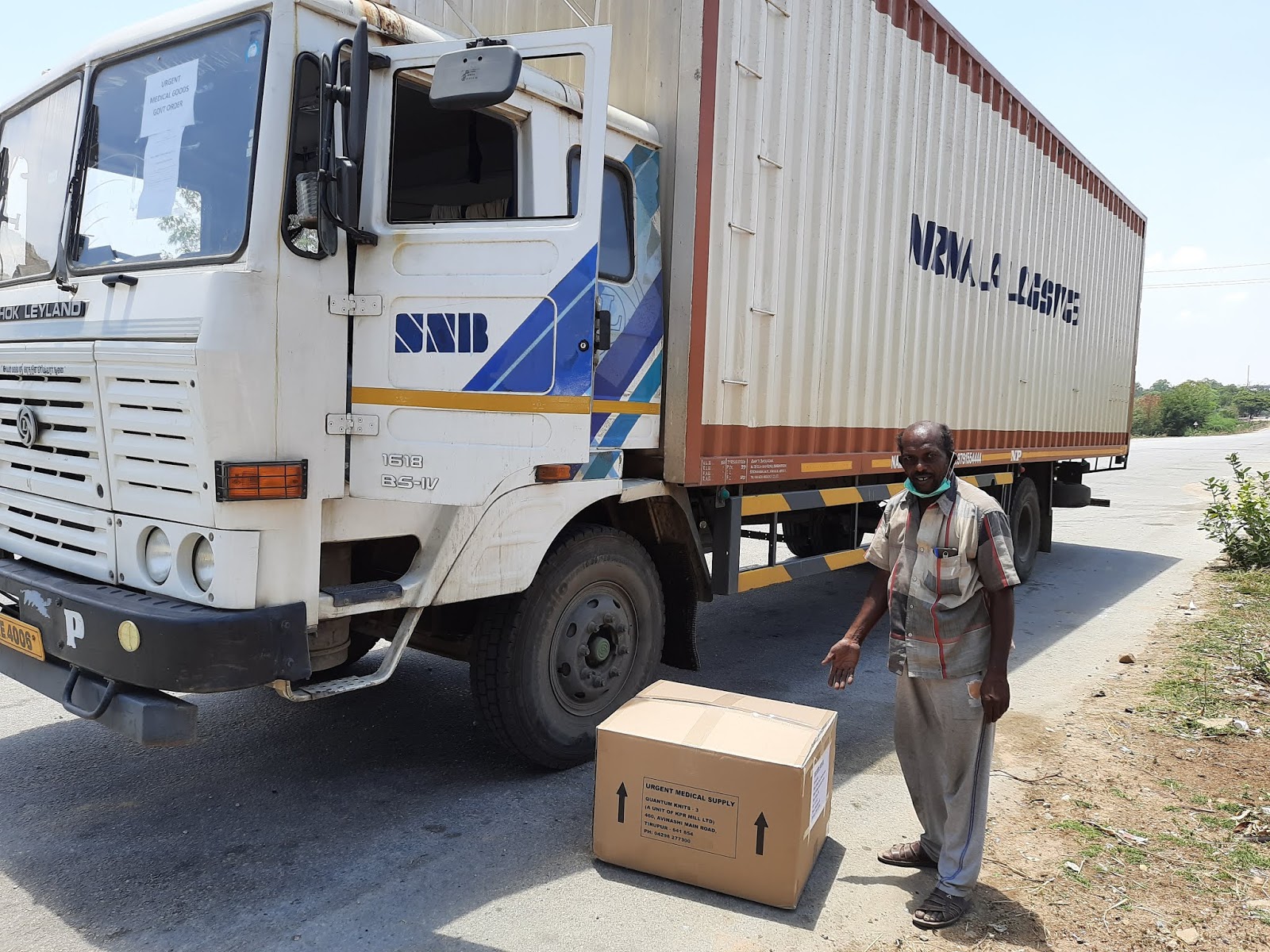
The truck with PPE
PPEs made by KPR mills were dispatched from Coimbatore in a truck carrying a massive consignment to Hyderabad.
The mill owners are parents of Rishi Valley School and made these PPEs available to us.
The truck was diverted through Madanapalle and at about 1200 on Sunday, the truck driver contacted me saying he was approaching the Rishi Valley Cross. Thanks to GPS,  precise coordinates were given and I drove to the main road (3 km) to pick up the full PPEs. Will start using them as and when needed.
    
Transferred to my car
Unloading at RHC


Teaching on how to use the sprayer
Spraying in progress
DISINFECTION
Using a hand operated knapsack sprayer with a solution of Bleaching powder all the common user surfaces are sprayed 3 times a day. A video and photo are given below


Afterword
The virus continues to sweep across the country. The lockdown has definitely helped in dramatically slow the progression of this virus. People have also slowly adjusted to a new normal.
However, economic activities have taken a hit all over.
In our area with the harvesting of Tomato almost over, there was not much activity. Milk production has continued in the villages with supplies to the dairies as well as the nearby town of Madanapalle continuing
Floriculture and vegetable selling took a big hit as there was no market to go and sell the produce to.
So also daily wage workers and itinerant salesmen (bangle sellers, pani puri sales, loaders in the mandi's, street vendors of vegetables/fruits, roadside dhabas, tyre repair shops etc) all took a big hit.
However, the spirit of the people remains high and there are hopes of containment and acceptance of a new normal.
Jai Hind


Tuesday, April 21, 2020

Rural Life in COVID

Rural life somehow carries in. Agricultural activities somehow have to be kept going, albeit in a small scale. This anyway is true of our region with small holdings, largely farmed without much labour. Farmers tend to help each other out in times of planting, harvest etc.


A family set up shop on the road side with tomatoes, greens, gourds and ladies finger, all grown locally. Farm fresh. It also gave the kids, who had no school something to do.


This old lady set up shop selling musk melons straight from the field. I have not had such sweet melons.
One can see the fields in the background


A truck brought in 28 tonnes of bananas from Pulivendla, about 130 km from us. However the market yard took only 15 tonnes. The rest was literally left in the truck. Villagers got together to buy the produce at literally throw away prices of Rs 100 for a bunch of bananas. This translates to about Rs 3/kg.
A lot of the bananas were squashed and fit only as animal fodder


A family collecting the bananas to take home


Kids at play on the road - no school so happy times

Tuesday, March 17, 2020

In the times of COVID 19

0730 AM - A couple of three seat Auto Rickshaws draw up disgorging about 08 passengers each. Passengers comprise elderly, the middle aged and a couple of young kids. The older ones make a beeline to the laboratory - these are patients of Diabetes who have started coming in for their blood tests.
0800 AM - By this time a crowd of about 60 patients has collected, about 40 of them milling around the laboratory. The rest wait in front of the registration - jostling, shoving to be first in the queue. Being early means that the wait time to see the doctor is less and they can then get home.
The laboratory assistants arrive and set up equipment for the day.
One of the attendants collects the books/lab slips and lines them up.
An announcement is made
1. All those who have cough, breathing difficulty or fever step aside
2. All those who have returned from Kuwait (used generically for the middle east) in the last 2 weeks please step aside.
There are a fair number of people who work in the Mid East as labour, servants, cooks, drivers, goat herds etc.
The idea is to fast track these patients and get them home quickly.
About 10 patients put up their hands and are taken in first to the lab.
Fasting blood tests done they are asked to wait at a specified place in front of my room.
0830 AM:
The bus from Madanapalle draws up and about 40 patients get down - there is much pushing and shoving to get to the queue either to the lab or to the registration
The registration opens and the patients continue to jostle for that 1/2 inch gain in the line. No amount of entreaties work!!!
I come in along with Dr Anandhi and we take a look at the patients waiting for new registrations. The numbers in the lab are huge and there are large number of patients for review - probably around 120 - 130. Can we see all these patients? This is a call we have to take and one has to be very hard hearted to say NO to a patient who has come from far seeking succour.
Finally we give appointments to a few and the rest - about 20 of them are taken in.
0845 AM: pen down - and the first patient
1. A 60 yr old man, Diabetic, Chronic Obstructive Pulmonary Disease (COPD) - Coughing and wheezing. A quick assessment - no fever, no wet cough - OK Nebulise him, give him inhalers and off you go.
2. 20 year old woman - Cough, fever x 5 days. She works in Hyderabad - ah ha the warning bells go off. She has just come off the night bus and straight to the Health Centre. The poor thing looks so scared - she probably saw my expression change when she said Hyderabad! Anyway I examine her - Just a mild Upper Respiratory - reassurance, medications and send her off with a warning that in case it gets worse go to a Government facility.
The next few are old patients of Asthma or COPD - all a little nervous since the COVID message has been playing non stop on the cell phones - lots of reassurance and cheer do the trick.

Distancing? What is that in the context of such a large number of patients landing up in overcrowded Auto rickshaws and buses?
What about doctors? The length of a stethoscope is 45 cm - much less than the mandates 1 metre
Can these rules be followed in a country like ours, with such a large population and so many needing health care under even normal circumstances?
I don't have the answers but am wondering about the practicality of the repeated reminders on Social Distancing.

Hygiene? Its a daily battle to prevent patients from hawking, spitting bringing out phlegm and just letting loose - Cough and sneeze hygiene - forget it! Carrying a handkerchief - you must be joking!
In all the crowd there will be a couple of youngsters who wear a handkerchief around their nose and mouth.
Water is at a premium - particularly when one has to fetch it from a communal tap. Why waste water on washing? Use hot sand or better still don't wash!! That's an option many of us, who read this will not even understand. We are so used to our 24 hr water supply.

Job Losses: Towards the end of the day a smartly dressed young man accompanies his father to my room. The father is a Diabetic and has been so for many years. He has come to the RHC for treatment. After I finish my examination and spiel on diet etc, I spend time with the young man.
He had till about a week ago a flourishing single man hair cutting shop in Electronic city, Bengaluru. Ever since COVID hit, work from home has started. He has steadily lost clientele and income. He has now come back to his village to ride out the storm. His family is dependent on his income. What's going to happen?
What will happen to the parking attendants, sweepers, baggage cart handlers at Bengaluru Airport? many of them are migrant workers from near our area. They will be all out of jobs and their families will suffer.

School Closures: Yes great idea to mitigate crowding. But what will happen to the kids whose only source of nutritious food is the MID DAY MEAL. They will now be forced to stay at home and help out in the fields or household chores. Typically in rural communities both parents work - and they work long hours. How do these parents make time for their kids? So not only do these kids miss out on meals they also miss out on education.

Hospitalisation?: If someone from the village gets a Pneumonia and progresses to Respiratory Distress (ARDS in medical terms) - they have to travel 120 - 150 km to a tertiary care centre at Tirupati or Bengaluru. Many a time - even under normal circumstances, there are no ventilators available. Whatever can be done is done.
The call on how much to do is routinely taken by doctors. Many a time I have spent time with  a seriously ill patient's relatives laying out the pros and cons of taking such patients to a higher centre. Some of them choose to stay at home and we provide palliative medications to the extent possible and also teach them the basics of home care.
Others choose to go - some pull through and the others pass on.

Afterword: Yes COVID is a frightening reality. It is sweeping through the world. I shudder to think what will happen if it takes root in a community. The already stretched medical system will possibly break under the burden of disease. I read that hospitals are closing down since doctors got infected. Yes we doctors need to protect ourselves but then what about the people who depend upon us. Its like saying that the Armed Forces will cease to fight because a few soldiers got killed!!!
The GOI has done a tremendous job of keeping tabs on the epidemic. Village level volunteers have gone house to house checking on foreign returnees. These get a call from the Primary Health Centre checking on their status. More labs are being roped in to do tests. Here's hoping that the COVID involutes upon itself. Till then we continue to do what we are trained to do - PROVIDE HEALTH CARE TO THE SICK & NEEDY
Jai Hind
Kartik